
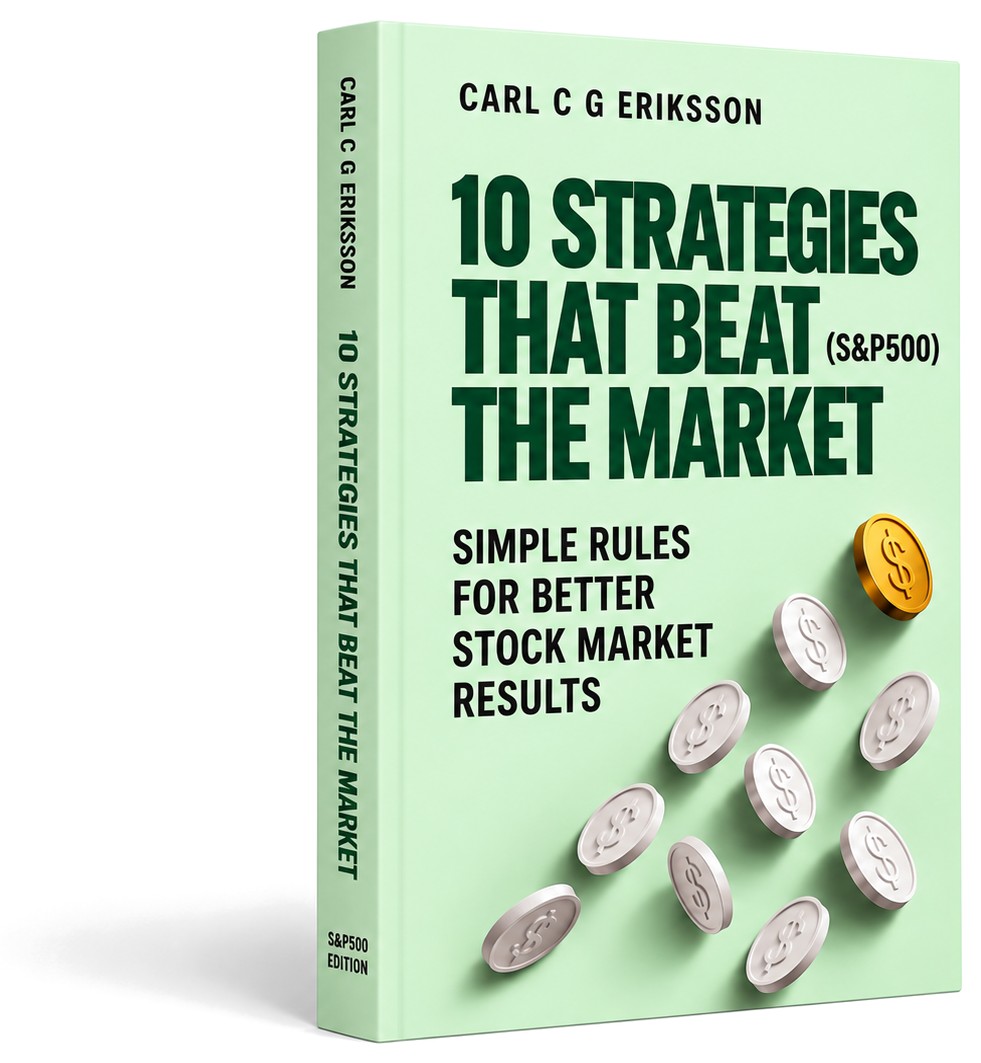
The book
10 strategies
that beat the market
Ten rule based strategies, every entry and exit written out, backtested on the S&P 500 from 1950 to 2026 and run again on thirty of the largest companies in the index.
What is inside
Ten strategies, every rule on the page
No single strategy in this book out-earns buy and hold in raw dollars, and the book says so on its second page. What they do instead is get most of the work done with a fraction of the exposure.
Buying the S&P 500 in 1950 and holding to September 2026 turned a $10,000 position into +$72,064, and cost a worst moment of $7,631 along the way. Strategy 4 made +$22,120 with a worst moment of $1,288, in the market 5.47 per cent of the time. That trade off is what the book is about.
The ten strategies
Strategy 0 is the worked example that teaches the format, and the two bonus strategies come after the ten. Each one gets a historical trade, its entry and exit rules, its index statistics and its results on thirty individual stocks.
The full table of contents8 parts, 13 strategies, every backtest report
Part 1
The book, and how to read it
- The problem
- How the book is built
- Choose your starting point
Part 2
Stocks, the market and the road into quantitative strategies
- Thoughts on returns
- What is the S&P 500
- What outperformance means
- What long and short mean
- What is quantitative analysis
- What is a backtest
- Investing versus trading
- Technical, fundamental and quantitative analysis
Part 3
The fundamentals of quantitative trading
- Think in probabilities
- Positive expectancy
- Terminology
- Reading a backtest
- The parts of a backtest report
- What you need to know
Part 4
The ten strategies
- What the strategies have in common
- How they differ
- How to use them
- Strategy 0 through Strategy 10
- Two bonus strategies
Part 5
Using the strategies effectively
- Running all ten together
- Psychology as a quantitative trader
- A diversified portfolio handles drawdowns
- Managing risk
- The pitfalls of trading and backtesting
- Your trading plan
Part 6
How the strategies were built, and how to improve them
- From tens of thousands of ideas to ten
- Curve fitting and overfitting
- In-sample and out-of-sample
- Stops, targets and trailing stops
- The metrics in a backtest
Part 7
Your first steps as a quantitative trader
- Tips for a quantitative trader
- Do not forget the risks
- One last thought
Part 8
Backtest reports and code
- The code for all thirteen strategies
- The S&P 500 backtest report for each one
Before you buy
Is this your book?
Yes, if
- You already hold index funds and want to know what the alternative actually costs
- You want rules you can read, test and argue with, not a signal service
- You are willing to sit out most trading days. Several of these are in the market under 6 per cent of the time
- You have never run a backtest and want to understand what the numbers in one mean
No, if
- You want the largest possible dollar return. Buy and hold wins that contest here, and the book says so early
- You want a daily signal to copy. The rules are printed, the execution is yours
- You want options, crypto or intraday scalping. This is end of day work on shares and the index
Also by Carl
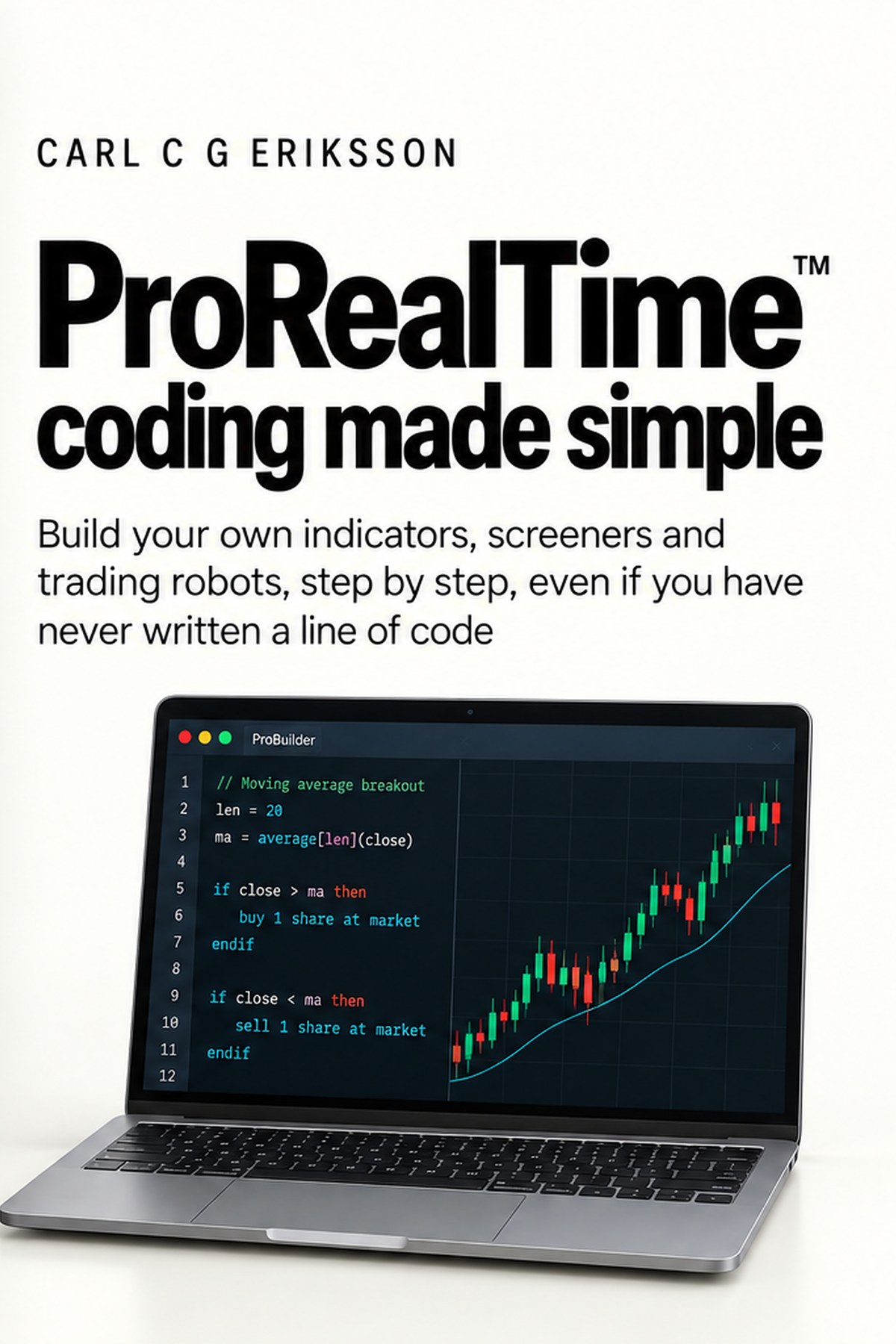
ProRealTime coding made simple
The coding book. Build your own indicators, screeners and robots in ProRealTime, even if you have never written a line of code.
See the book
10 strategier som slår börsen
The same ground on the Swedish market, in Swedish, published by Sterners Förlag.
See the bookFree resources
Four things that are already free
The programme
27 lessons, free, no account
Finding an edge, testing it honestly and running it live. The process behind the robots, in video and worked examples.
The reference
301 ProBuilder instructions
Every instruction with its syntax and the common errors that come with it. The book teaches, this one answers.
The strategies
200 strategies, coded
Entry and exit rules written out as ProBuilder, ready to read, run and pull apart. Worked examples for every chapter.
The statistics
What the numbers actually look like
Published results and risk figures for the algos, so you have something real to hold your own backtests against.